Key question
How to create sustainable, resilient livelihood for peri-urban populations?
Specific questions
- How multiple hazards affect peri-urban areas.
- How urbanization & climate change affect livelihood.
- How housing & infrastructure relate to climate & livelihood.
- How these affect quality of life.
- How climate justice can be increased through adaptation governance.
- How livelihoods are connected within complex SET systems.
Research design
FLASH comprises six interrelated and complementary work packages (WP), presented in the following Figure.
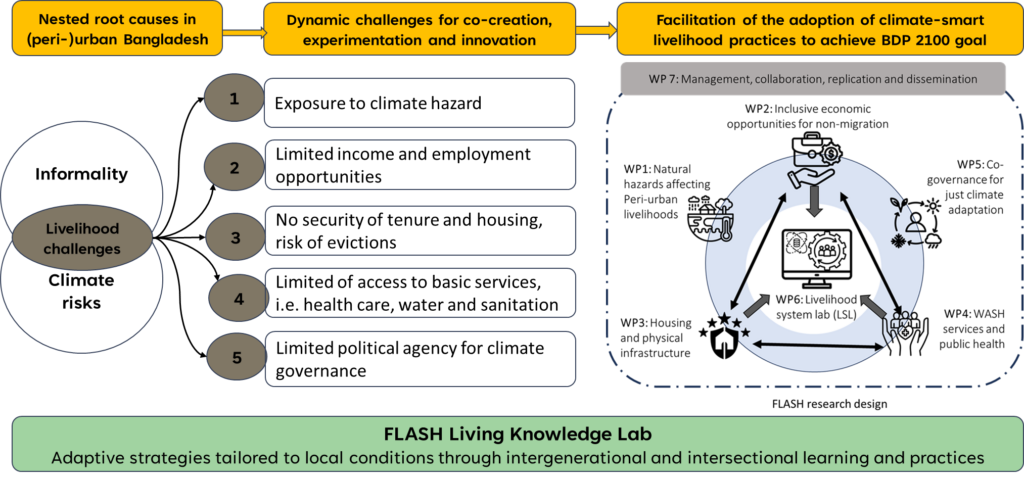
FLASH is organised around the Livelihood System Lab (LSL) in WP6, which integrates evidence from WP1–WP5 to co-develop and test adaptive, data-driven livelihood strategies. Employing Living Lab (LL) approach through continuous two-way feedback, the LSL strengthens research across hazards, economic opportunities, housing, WASH, health, and co-governance, while WP7 supports coordination, knowledge exchange, replication, and dissemination.
Project location
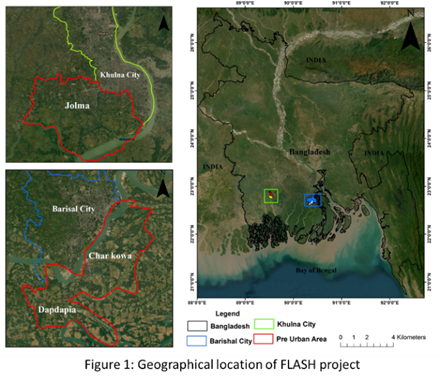
FLASH focuses on peri-urban communities in Khulna and Barisal (Fig 1), where rapid, often unplanned urban expansion is transforming agricultural land and livelihoods. Facing increasing climate risks, land-use change, and infrastructure pressures, these dynamic coastal settings provide critical living laboratories for co-creating inclusive, climate-resilient livelihoods and sustainable urban futures.